
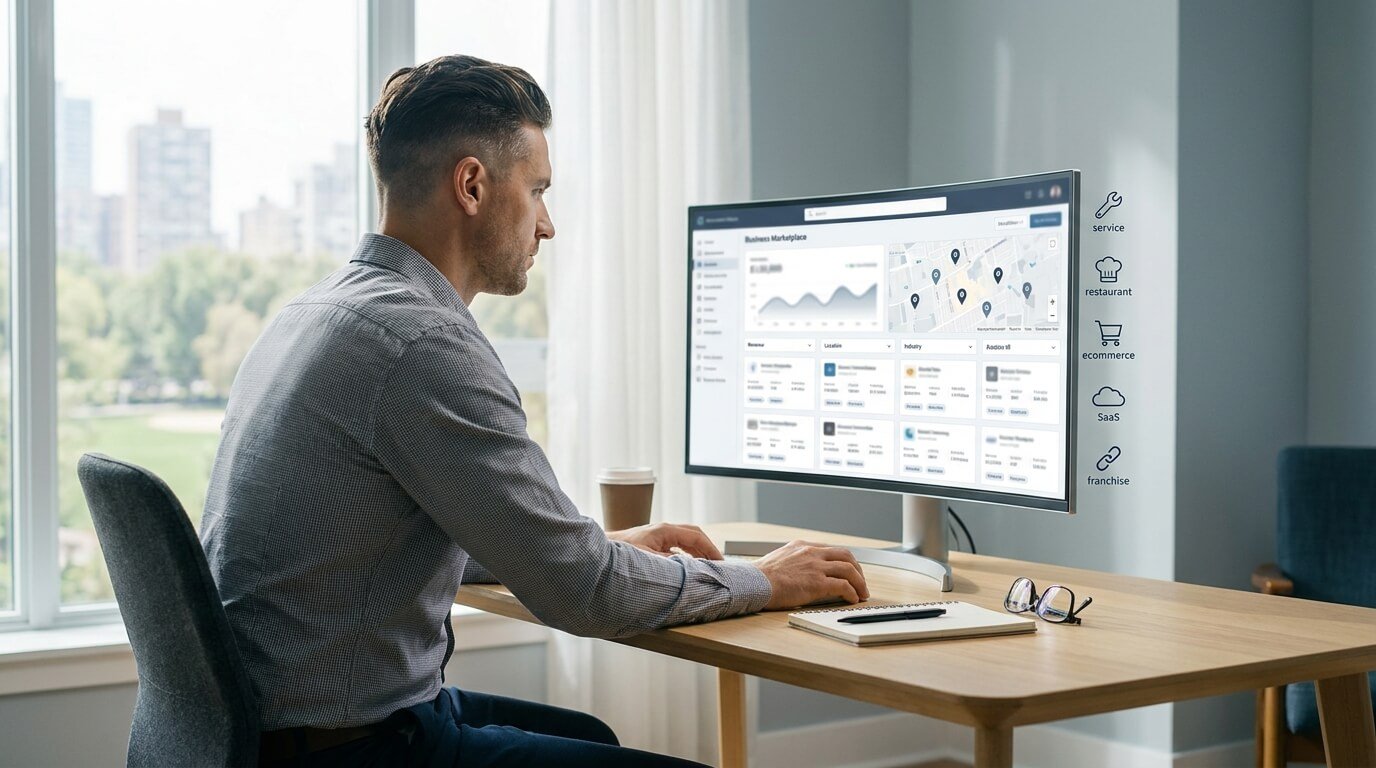
Finding a business to buy is easier than it used to be. Finding a business that is actually worth buying is much harder.
The best website for buying a local service company may not be useful for someone looking for a SaaS business. A buyer searching for a small website, a franchise, a restaurant, or a larger private company may need completely different sources.
That is why the best business deal website depends on what you want to acquire.
Quick answer: Start with BizBuySell if you are looking for a traditional U.S. small business. Flippa is a strong starting point for websites and other online businesses. Acquire.com is more focused on startups and digital businesses, particularly SaaS. BusinessesForSale.com is useful when your search extends beyond one country.
But the marketplace is only the beginning.
A business listing can help you discover an opportunity. It does not tell you whether the business is a good investment.
Key Takeaways
- Different business-for-sale websites specialize in different types of acquisitions.
- Local businesses, websites, SaaS companies, franchises, and larger companies are not usually found through exactly the same channels.
- The asking price is not the same as the value of the business.
- Marketplace verification does not replace independent due diligence.
- Buyers should evaluate the business itself, not simply trust the quality of the listing or the reputation of the marketplace.
- The best acquisition opportunities are sometimes found through brokers, industry contacts, or direct owner outreach rather than public listings.
What Are Business Deal Websites?
Business deal websites are online platforms where buyers can discover companies, websites, franchises, startups, and other businesses that may be available for acquisition.
Depending on the platform, you may find:
- Local service businesses
- Restaurants and retail businesses
- Franchises
- Ecommerce companies
- Content websites
- Digital agencies
- SaaS companies
- Mobile apps
- Amazon businesses
- Professional practices
- Larger private companies
The important point is that these are not all the same type of acquisition.
Someone looking for a $100,000 local service company has different needs from an investor looking for a multi-million-dollar company. A developer buying a SaaS business will also evaluate different risks than someone purchasing a laundromat.
Before choosing a marketplace, define what you are actually trying to buy.
10 Best Websites and Platforms to Buy a Business
1. BizBuySell. Best Starting Point for Traditional U.S. Small Businesses
BizBuySell is one of the most obvious starting points for buyers searching for established businesses in the United States.
Its marketplace covers a wide range of industries, including restaurants, franchises, service businesses, retail companies, manufacturing, healthcare businesses, automotive businesses, and online businesses. The platform also provides filters that can help buyers narrow searches by location, industry, asking price, and other criteria.
Best for
- Traditional small businesses
- Local businesses
- Service companies
- Restaurants
- Franchise resales
- Buyers comparing several industries
What to check
A large marketplace gives you more opportunities, but listing quality can vary.
Do not treat displayed revenue or cash-flow numbers as final proof of the business’s financial health. Once you find a serious opportunity, you still need to verify financial records, customer relationships, contracts, liabilities, and the owner’s role.
Best starting point for: Buyers looking for an established U.S. business rather than a purely digital acquisition.
2. Flippa — Best for Websites and Online Businesses
Flippa specializes in online businesses, websites, and digital assets.
Its marketplace includes businesses such as websites, ecommerce companies, SaaS businesses, apps, content businesses, and other digital properties.
This makes it particularly relevant for entrepreneurs who understand online traffic, digital marketing, ecommerce, software, or online operations.
For example, a marketer might prefer acquiring an existing website with established traffic rather than building a new site from zero.
That does not automatically make the acquisition safer.
The buyer still needs to understand where the traffic comes from, how the business makes money, whether revenue is recurring, and how dependent the business is on a particular platform.
Best for
- Websites
- Ecommerce businesses
- Content sites
- Digital assets
- Apps
- Online businesses
What to check
For an online business, investigate:
- Traffic sources
- Traffic trends
- Revenue sources
- Conversion rates
- Customer concentration
- Platform dependency
- Advertising costs
- Backlink profile where relevant
- Operating workload
A website that receives most of its traffic from one search engine, advertising platform, marketplace, or social network may carry significant concentration risk.
Best starting point for: Buyers whose acquisition target exists primarily online.
3. Acquire.com — Best for SaaS and Startup Acquisitions
Acquire.com focuses on buying and selling online businesses and startups, including SaaS companies, ecommerce businesses, agencies, content businesses, newsletters, and mobile apps.
This can make it particularly useful for buyers who want to acquire a technology-driven or internet-based company.
The platform itself reports significant transaction activity and buyer participation, but those figures should be periodically verified before publication because marketplace statistics can change.
Best for
- SaaS businesses
- Startups
- Software products
- Digital agencies
- Technology companies
- Online entrepreneurs
What to check
Recurring revenue alone does not make a SaaS business attractive.
Look at:
- Customer churn
- Retention
- Customer concentration
- Gross margins
- Customer acquisition costs
- Product dependencies
- Technical debt
- Security responsibilities
- Founder involvement
- Competition
A SaaS business can appear attractive when evaluated only through revenue multiples while hiding operational or retention problems.
Best starting point for: Buyers specifically searching for SaaS, startups, or established digital businesses.
4. Empire Flippers Best for Established Digital Businesses
Empire Flippers is another platform worth comparing when you are looking for an established online business.
It can be relevant to buyers interested in businesses such as ecommerce companies, content businesses, affiliate sites, and other internet-based operations.
Best for
- Established online businesses
- Ecommerce
- Content businesses
- Affiliate businesses
- Experienced digital buyers
What to check
Do not assume that a more curated marketplace removes the need for independent investigation.
You still need to understand:
- Where revenue comes from
- Whether traffic is sustainable
- How much work the owner performs
- Which assets transfer to the buyer
- Whether important accounts or supplier relationships can be transferred
Best starting point for: Buyers who want to compare more established online businesses.
5. BizQuest — Best for Comparing U.S. Business Opportunities
BizQuest is another broad marketplace for buyers searching for businesses and franchises.
It includes businesses across categories such as restaurants, automotive businesses, construction companies, internet businesses, manufacturing, healthcare, and other industries.
The main advantage of checking more than one marketplace is simple: not every seller lists everywhere.
Best for
- U.S. small businesses
- Local businesses
- Franchise opportunities
- Buyers comparing industries
What to check
Use the platform for discovery rather than assuming the marketplace has already completed every investigation you would need as a buyer.
Compare multiple opportunities and then move into detailed verification once a business fits your acquisition criteria.
Best starting point for: Buyers who want another major source to compare alongside BizBuySell.
6. BusinessesForSale.com — Best for International Searches
BusinessesForSale.com can be useful when your acquisition search is not limited to one country.
The marketplace covers businesses across multiple locations and industries.
Best for
- International buyers
- Cross-border acquisitions
- Businesses outside the U.S.
- Buyers comparing opportunities across countries
What to check
International acquisitions can involve additional complexity.
Depending on the transaction, investigate:
- Ownership restrictions
- Local licensing
- Tax obligations
- Currency exposure
- Employment rules
- Transfer restrictions
- Local legal requirements
A business that appears attractive on a marketplace can look very different once transaction costs and local regulations are considered.
Best starting point for: Buyers considering businesses outside their home market.
7. DealStream — Best for Broader Deal Discovery
DealStream can be useful for buyers exploring opportunities beyond a conventional small-business search.
Broader deal platforms can expose buyers to opportunities that do not fit neatly into categories such as local businesses, websites, or franchises.
Best for
- Broader acquisition searches
- Investment opportunities
- Specialized opportunities
- Buyers exploring multiple markets
What to check
The broader the opportunity pool, the more important it becomes to understand exactly what is being offered.
Before moving forward, clarify:
- What assets are included
- Who represents the seller
- Whether the financial information is supported
- What liabilities may transfer
- What the buyer is actually acquiring
Best starting point for: Buyers whose search is broader than a standard small-business marketplace.
8. Axial — Best for Larger Lower-Middle-Market Acquisitions
Axial is different from a typical public marketplace.
It operates as a private deal network focused on lower-middle-market transactions and is aimed more toward professional buyers, investors, business owners, and M&A participants. Axial describes its platform as serving North American companies within defined revenue and EBITDA ranges.
Best for
- Larger acquisitions
- Professional buyers
- Investors
- Strategic acquisitions
- Lower-middle-market companies
What to check
Larger acquisitions usually require deeper financial, operational, legal, tax, and commercial due diligence.
This is generally not the first place a buyer should start when searching for a small local business.
Best starting point for: Experienced buyers and professionals pursuing larger transactions.
9. Local Business Brokers — Best for Confidential or Specialized Deals
Not every business for sale is publicly listed.
A local business broker may know about owners who are considering selling but have not yet advertised the business publicly.
This can be particularly useful when you are looking for a specific:
- City
- Industry
- Revenue range
- Business size
- Professional practice
- Owner-operated company
Best for
- Local acquisitions
- Confidential opportunities
- Specialized industries
- Buyers who want professional assistance
The advantage is access to local relationships and transaction experience.
The downside is that the search process may be less convenient than browsing a large public marketplace.
Important: A broker’s involvement does not eliminate the buyer’s responsibility to perform due diligence.
10. Direct Owner Outreach — Best for Off-Market Opportunities
Direct outreach is not a marketplace, but it can be one of the most useful acquisition strategies when you have a very specific target.
Imagine you want to acquire an established HVAC company in a particular city.
Instead of waiting for a suitable listing to appear, you could identify companies that match your criteria and contact owners professionally to ask whether they have considered selling.
For example:
“I’m interested in acquiring an established business in this industry and market. If you have considered selling now or in the future, I would be interested in discussing whether there could be a fit.”
There is no guarantee the owner is interested.
However, direct outreach can help you discover businesses that are not being marketed publicly.
Best for
- Off-market opportunities
- Highly specific acquisition targets
- Local businesses
- Niche industries
Best starting point for: Buyers with clearly defined acquisition criteria.
Which Platform Should You Use?
The easiest way to choose is to start with the type of business you want.
| Your Goal | Good Starting Point |
|---|---|
| Buy a traditional U.S. small business | BizBuySell |
| Compare U.S. business opportunities | BizQuest |
| Buy a website or digital business | Flippa |
| Buy a SaaS company | Acquire.com |
| Find an established online business | Empire Flippers |
| Search internationally | BusinessesForSale.com |
| Explore broader opportunities | DealStream |
| Pursue a larger acquisition | Axial |
| Find confidential local opportunities | Business brokers |
| Find off-market businesses | Direct owner outreach |
These are starting points rather than guarantees.
The quality of the individual business matters more than the reputation of the marketplace where you found it.
How to Tell Whether a Business Deal Is Actually Good
Finding the listing is only step one.
The real question is whether the business can justify the price and whether the risks are acceptable for you.
Look Beyond Revenue
Revenue tells you how much money entered the business.
It does not automatically tell you how much money the owner keeps.
Review the business’s financial picture carefully, including:
- Revenue
- Gross profit
- Operating expenses
- Cash flow
- Net income
- Seller’s discretionary earnings where relevant
- EBITDA where relevant
Do not rely on a single number.
Understand Why the Owner Is Selling
There are many legitimate reasons to sell a business.
The owner may be retiring, relocating, changing careers, dealing with family priorities, or pursuing another opportunity.
The important thing is to investigate the explanation.
Ask follow-up questions and compare the seller’s explanation with the business’s financial and operational history.
Check Customer Concentration
A business can appear healthy until you discover that one customer produces most of its revenue.
Ask:
- Who are the largest customers?
- How much revenue does each customer represent?
- Are contracts transferable?
- How stable are those relationships?
- What happens if a major customer leaves?
Customer concentration can significantly change the risk of an acquisition.
Check Owner Dependency
Ask yourself:
What am I actually buying besides the current revenue?
If the owner personally handles sales, operations, supplier relationships, technical work, and customer relationships, the business may be heavily dependent on that person.
Look for transferable assets such as:
- Employees
- Documented systems
- Customer relationships
- Supplier agreements
- Operating processes
- Intellectual property
- Brand assets
For Online Businesses, Check Traffic Quality
Do not assume that a website is healthy simply because it reports a certain number of visitors.
Understand:
- Where traffic comes from
- Whether traffic is increasing or declining
- Which pages generate revenue
- Whether paid advertising is required
- Whether search traffic depends heavily on a small number of keywords
- How visitors convert into customers or revenue
A digital business that depends heavily on one platform may face significant risk if that platform changes its rules or algorithms.
Business Listing Red Flags
Be cautious when you encounter:
- Revenue claims without supporting documents
- Large unexplained increases in sales
- Declining trends hidden by long-term averages
- Extreme customer concentration
- Heavy owner dependency
- Missing financial statements
- Numbers that do not match across documents
- Pressure to send money before reasonable checks are completed
- A valuation based mostly on future potential
- A seller unwilling to answer basic questions
A professional-looking listing is still marketing.
Your due diligence determines what you are actually buying.
What Does “Verified” Mean on a Business Marketplace?
The word verified can mean different things.
Depending on the platform, verification may relate to:
- Seller identity
- Business ownership
- Revenue information
- Financial documentation
- Website traffic
- Buyer funds
These are not interchangeable.
For example:
- A verified seller does not automatically mean the business is profitable.
- Verified revenue does not automatically mean the asking price is reasonable.
- Verified traffic does not guarantee that the traffic will continue after the acquisition.
Before relying on a verification badge, find out exactly what the platform verified and what it did not.
Can You Finance a Business Found Online?
Possibly.
Depending on the business, buyer, and transaction structure, financing options may include:
- SBA-backed financing where applicable
- Conventional business loans
- Seller financing
- Investor funding
- Earn-outs
- Combination financing
A marketplace listing that mentions financing does not mean you have been approved.
The U.S. Small Business Administration recommends that prospective buyers investigate the full business landscape, including contracts, cash flow, inventory, licensing, and other factors before buying an existing business.
Before pursuing financing, buyers may need information such as historical financial records, tax documents, business debt information, purchase terms, and their own financial information.
Requirements vary by lender, jurisdiction, and transaction.
Business Marketplace vs. Business Broker
A marketplace gives you access to listings.
A broker can provide access to relationships and help guide a transaction.
A marketplace may be sufficient when you want to research independently.
Professional assistance may become more important when the transaction involves:
- Significant financing
- Multiple owners
- Complex contracts
- Real estate
- Confidential negotiations
- Specialized industries
- Large acquisition values
You do not necessarily have to choose one approach.
A practical strategy is to use marketplaces to identify opportunities and then bring in qualified legal, financial, tax, or transaction professionals when a serious deal moves forward.
How to Choose the Right Business Deal Website
Before creating accounts on every platform, answer these questions.
What Type of Business Do You Want?
Be specific.
Are you looking for:
- A local service company?
- A restaurant?
- A franchise?
- An ecommerce business?
- A website?
- A digital agency?
- A SaaS company?
Your answer should determine where you search.
What Is Your Realistic Budget?
Do not automatically treat all available cash as money you can spend on the purchase price.
You may also need funds for:
- Working capital
- Professional fees
- Unexpected expenses
- Initial improvements
- Operating costs
The amount required depends heavily on the transaction.
Does the Business Match Your Skills?
A business that fits your existing knowledge may be easier to evaluate and operate than one that requires you to learn an entirely new industry immediately after closing.
That does not mean you must buy only businesses in your current field.
It means you should realistically account for the learning curve and operational risk.
How Much Support Do You Need?
First-time buyers may prefer a marketplace with more guidance or professional support.
Experienced buyers may be comfortable sourcing and evaluating opportunities independently.
Are You Willing to Consider Off-Market Deals?
If your target is highly specific, public listings may not be enough.
Consider combining marketplace searches with:
- Broker relationships
- Industry contacts
- Networking
- Direct owner outreach
Frequently Asked Questions
What is the best website to buy a business in 2026?
There is no single best platform for every buyer. BizBuySell is a strong starting point for traditional U.S. small businesses, Flippa is relevant to many online-business searches, and Acquire.com is more focused on startups and digital acquisitions. The right choice depends on the type of business you want to buy.
What is the best website to buy an online business?
Flippa, Empire Flippers, and Acquire.com are worth comparing. The right platform depends on whether you want a small website, an established digital business, or a SaaS or startup acquisition.
Are business-for-sale websites safe?
Established marketplaces can be useful for discovering opportunities, but no marketplace can guarantee that every listed business is a good investment. Buyers should independently verify important financial, operational, legal, and ownership information.
Can I buy a business with no previous experience?
Yes, but the business should fit your skills, available resources, and ability to manage the operation. First-time buyers may find businesses with documented systems, transparent financial records, and established employees easier to evaluate than highly complex businesses.
Can you negotiate the asking price of a business?
Often, yes. The asking price is not automatically the business’s true value. Negotiation may depend on financial performance, comparable transactions, seller motivation, assets, financing, and the overall deal structure.
What should I check before buying a business?
At minimum, investigate historical financial performance, customer concentration, contracts, debt, assets, employees, owner responsibilities, transferability, and the reason for the sale. For online businesses, also investigate traffic sources, analytics, revenue sources, and platform dependency.
Is a cheap business automatically a good deal?
No. A low price may reflect declining revenue, weak profits, outdated assets, customer concentration, heavy owner dependency, or other problems.
The value of a business depends on what you are actually acquiring and the risks involved, not simply the asking price.
Final Verdict
The best business deal website is not necessarily the one with the most listings.
It is the one that helps you find businesses that match your acquisition criteria.
For traditional U.S. small businesses, start with BizBuySell and compare opportunities through BizQuest.
For websites and other digital businesses, start with Flippa and compare established opportunities through Empire Flippers.
For SaaS and startup acquisitions, Acquire.com is a logical place to begin.
For international searches, BusinessesForSale.com can broaden your options.
But remember the most important distinction:
Finding a business listing is not the same as finding a good business deal.
Use marketplaces to build a shortlist.
Then investigate the numbers, understand the risks, confirm what assets and obligations will transfer, and decide whether the business fits your skills, budget, and acquisition goals.
That process—not the marketplace itself—is what turns an interesting listing into an acquisition worth considering.
nnRelated resources: How to Start a Junk Removal Business (Step-by-Step Guide 2026) · How to Start a Vending Machine Business: 7 Proven Steps