
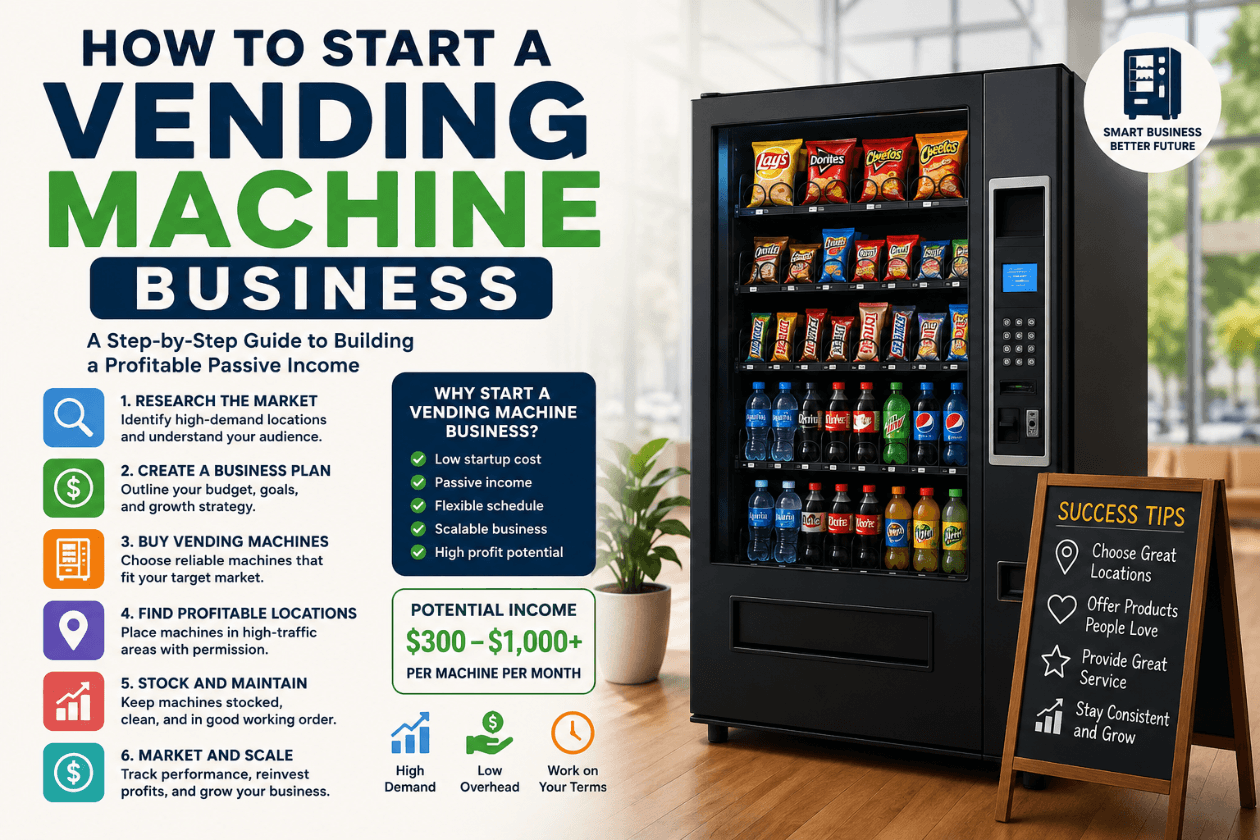
How to Start a Vending Machine Business: 7 Proven Steps

How to Start a Vending Machine Business? Vending machines get sold online as passive income. They aren’t. A machine still needs product, a working payment system, and someone who shows up when it breaks. What makes vending worth pursuing is that it’s one of the few businesses you can start for a few thousand dollars, run without employees, and scale by repeating a formula that already works once you know what that formula actually is.
U.S. vending machine operators are projected to generate roughly $7.9 billion in revenue in 2026 and the category keeps expanding as cashless payment adoption removes the last real friction point for buyers. The opportunity is genuine. So is the labor. Here’s what it actually takes to build a profitable operation, not a hobby that quietly loses money.
What a Vending Machine Business Actually Is
You own machines placed in other people’s buildings, under a negotiated agreement, and you’re responsible for stocking them, collecting revenue, and keeping them running. That’s the entire job description. Everything else location scouting, product selection, maintenance scheduling is just execution around that core loop.
Operators generally fall into two categories. Some run one or two machines as a side project alongside a full-time job. Others build a route of dozens of machines across a defined territory and treat it as their primary business, often hiring help once the fleet grows large enough to justify it. Neither path is wrong; they just require different amounts of time and capital.
Why Vending Still Works as a First Business
Overhead is the whole pitch. There’s no lease, no staff at small scale, and no inventory that expires the way a restaurant’s does. Demand also doesn’t swing with the economy the way discretionary retail does people buy snacks and drinks whether the market is up or down.
What’s changed recently is the equipment itself. Cashless readers, mobile payment support, and remote inventory monitoring now ship standard on most new machines, which cuts down the guesswork that used to eat into an operator’s week. Smart vending with IoT-based telemetry is one of the fastest-growing segments in the industry, precisely because it lets an owner check stock levels without driving to the site.
Startup Costs: What You’ll Actually Spend
Costs scale directly with how many machines you start with and whether you buy new or used.
| Setup | Typical Cost | Notes |
|---|---|---|
| Single used bulk/candy machine | $200–$1,500 | Lowest entry point, minimal features |
| Single new snack or combo machine | $2,995–$5,500 | Warranty included, cashless-ready |
| Two to three machines (mixed new/used) | $5,000–$15,000 | Most common first-year setup |
| Smart vending or micro market kiosk | $5,000–$15,000+ | Larger offices, corporate breakrooms |
A refurbished machine bought online can look like the better deal until the control board fails a few weeks in, at which point a repair can run several hundred dollars. Weighing a warranty against upfront savings matters more in this business than in most, because service calls eat directly into a thin margin.
Ongoing costs matter just as much as the machine price. Product typically runs about half of gross sales, location commission runs 10% to 25% of revenue depending on the site, and maintenance averages $50 to $100 a month per machine once you account for the whole fleet.
Types of Vending Machines
| Machine Type | Price Range | Best Fit |
|---|---|---|
| Bulk/candy | $200–$1,500 | Low-traffic spots, minimal upkeep |
| Snack | $2,995–$5,500 | Offices, breakrooms |
| Beverage | $3,000–$5,500 | Gyms, schools, public spaces |
| Combo (snack + drink) | $3,000–$5,000 | Most versatile first machine |
| Micro market / smart kiosk | $5,000–$15,000+ | Large corporate breakrooms |
| Specialty (fresh food, coffee, PPE) | $5,000–$15,000+ | Hospitals, factories, niche demand |
How the Money Actually Works
A location agreement sets the terms; you install the machine, stock it, and the machine handles the transaction cash, card, or mobile. Your margin is whatever’s left after product cost, the location’s commission cut, and card processing fees. On average, product costs eat about half of revenue, and commissions take another 10% to 25%, which is why a single machine nets somewhere between $40 and $120 a month after everything is accounted for.
That number is the one most sales pages leave out, and it’s the one that determines whether this business makes sense for you. One machine won’t replace an income. Fifteen or more machines can generate meaningful part-time income, and a fleet of fifty or more starts approaching full-time earnings though location quality changes that math substantially, which is covered below.
Step-by-Step: Starting Your Vending Machine Business
Step 1 — Register the Business Properly
Form an LLC, get an EIN from the IRS, and register with your state before you spend anything on equipment. The LLC matters here specifically because a machine causing injury or property damage becomes a personal liability issue without one.
Step 2 — Get Licensed Before You Buy a Machine
Every U.S. state requires business registration and a sales tax or seller’s permit for vending operators, and requirements diverge sharply from there. Florida requires an LLC, a general business license, and a sales tax permit through the state’s Department of Revenue. Other states layer on vending-specific permits, health permits for perishable food machines, or per-machine decals. Confirm your specific state and city rules first — this is not a step to guess your way through.
Step 3 — Lock In Locations Before You Buy Equipment
This is where most first-timers go wrong: they buy the machine, then go looking for somewhere to put it. Reverse that order. Approach property managers, gym owners, factories, and office buildings directly, and get a signed agreement covering commission percentage, exclusivity, and exit terms before you commit a dollar to a machine.
Step 4 — Match the Machine to the Location
An office building wants a snack-and-drink combo unit. A gym wants beverages and protein-forward snacks. A factory running 24-hour shifts wants a machine stocked for the graveyard shift, not the lunch crowd. Buying a machine before knowing this context is how inventory sits unsold for months.
Step 5 — Build in Cashless Payment From Day One
Cashless now accounts for the vast majority of vending transactions. A cash-only machine turns away a meaningful share of buyers before they ever reach for a wallet, so a card reader isn’t optional infrastructure anymore it’s baseline.
Step 6 — Install, Stock, and Test
Deliver the machine, load a starting product mix based on who actually uses the space, and run a test transaction before walking away. A jammed dispenser or failed card reader on day one damages the location relationship faster than almost anything else.
Step 7 — Set a Restocking and Maintenance Rhythm
Weekly restocking is standard for most locations. Track which products move and which sit, and adjust the mix every 30 days for at least the first quarter. This single habit separates operators who grow from operators who plateau at one machine.
Best Practices That Separate Profitable Operators From Everyone Else
- Start with one machine and get the process right before adding a second. Scaling a broken system just multiplies the mistakes.
- Prioritize captive-audience locations hospitals, factories, 24-hour facilities where customers have no nearby alternative. These sites can outperform general foot-traffic spots by several times over.
- Review sales data by product line every month, not by gut feeling.
- Set aside a maintenance reserve from monthly revenue so a single repair doesn’t erase a month’s profit.
- Put every agreement in writing. Handshake deals are the most common source of lost placements in this industry.
Common Mistakes to Avoid
| Mistake | What It Costs You | Fix |
|---|---|---|
| Buying the machine before the location | Idle capital, no revenue | Secure a written placement agreement first |
| Going cash-only | Lost transactions | Install a cashless reader immediately |
| Stocking based on personal preference | Dead inventory | Track sales data and adjust monthly |
| Skipping licensing | Fines, forced removal | Register and permit before buying equipment |
| Underestimating service time | Burnout, machine downtime | Budget one to two hours per machine per week |
| Buying used with no warranty | Surprise repair bills | Compare warranty coverage against savings |
Expert Tips for Faster, Smarter Growth
Treat your first three placements as a pilot, not the finished business. Measure net profit per machine, not gross sales, and let that number not enthusiasm decide where you put your next dollar. Once several machines are consistently profitable, reinvest that cash into new placements rather than spreading thin capital across too many sites at once.
Micro markets small, staff-free convenience setups in corporate break rooms represent one of the fastest-growing segments of the vending industry and are worth considering once your route has a few solid locations under it. Specialty categories like healthier snacks or workplace PPE vending can also command stronger margins in the right setting, though they typically require more research into supplier relationships than standard snack vending.
Real-World Examples
Solo side-hustle operator: Starts with one or two combo machines in a gym and an office building, funded with roughly $5,000 to $10,000 in savings, and handles restocking personally on weekends around a day job.
Captive-audience specialist: Focuses entirely on hospitals, factories, and 24-hour facilities. With 25 machines averaging $150 to $200 net per month in these higher-performing sites, monthly income lands around $3,750 to $5,000 a smaller machine count than a general foot-traffic route would need to hit the same figure.
Route-scale operator: Manages 50 or more machines across a defined territory, brings on a part-time route driver, and shifts from hands-on servicing into managing contracts and expansion.
Pros and Cons
| Pros | Cons |
|---|---|
| Low startup capital compared to most small businesses | Physically demanding, especially early on |
| No employees required at small scale | Thin margin per machine ($40–$120/month) |
| Flexible schedule around existing work | Requires 15+ machines for meaningful part-time income |
| Scalable, repeatable model | Location quality can make or break profitability |
| Tangible, resellable assets | Ongoing maintenance and breakdown risk |
Frequently Asked Questions
How much does it cost to start a vending machine business?
Expect $2,000 for a single used machine up to $15,000 for two or three new machines with branding and initial inventory. Most first-timers land comfortably between $3,000 and $5,000 for one or two cashless-ready machines.
How much money can I make with one vending machine?
Typically $40 to $120 per month after product, commission, and servicing costs. Location quality affects this figure more than the machine itself — a well-placed unit in a captive-audience site can outperform a machine in a busy but non-exclusive spot.
Do I need a license to run vending machines?
Yes. Nearly every state requires business registration plus a sales tax or seller’s permit, and some add health permits for perishable food machines or vending-specific location permits. Rules vary by state and city, so confirm locally before buying equipment.
Is vending machine income passive?
Not at small scale. Plan on one to two hours of hands-on work per machine per week for restocking and repairs. It moves closer to passive only once you’ve scaled enough to justify hiring a route driver.
How many machines do I need to replace a full-time income?
Fifteen or more machines typically generate meaningful part-time income, and fifty or more approaches full-time earnings — though strong captive-audience locations can cut that number substantially.
Should I buy new or used machines?
New machines cost more upfront but include a warranty that protects against the repair bills common with used equipment. On a tight budget, a warrantied new machine is often the lower-risk choice even at a higher sticker price.
What products sell best?
It depends entirely on the location offices and gyms lean toward healthier snacks and drinks, while factories and 24-hour sites favor traditional snacks and energy drinks. Track your first 90 days of sales data and adjust rather than guessing upfront.
Can I finance vending machine equipment?
Yes. Many distributors offer financing or promotional 0% APR plans on new machines, and small business loans are an option for a multi-machine launch. Compare financing costs carefully, since interest adds up quickly against already-thin vending margins.
Final Thoughts
The operators who make money in vending treat it like the logistics business it is: locations locked in before equipment is purchased, licensing handled upfront, machines matched to the site they’re serving, and a restocking rhythm that doesn’t slip. Start with one or two machines, get the numbers right, and let performance data not ambition decide when to add the next one. Done this way, learning how to start a vending machine business turns into building a real, ownable asset rather than chasing a passive-income story that never quite works out.